
 +86-(0)512-82283871

Content
- 1 1. Product Overview
- 2 2. Compact Design for Everyday Travel
- 3 3. Four-Wheel Configuration and Ride Confidence
- 4 4. Power System and Battery Performance
- 5 5. Motor, Controller, and Braking System
- 6 6. Capacity, Comfort, and User Considerations
- 7 7. Manufacturing Strengths and Product Development
- 8 8. Production Management and Quality Focus
- 9 9. Advantages Compared with Competing Travel Scooters
- 10 10. Operation, Safety, and Maintenance Guidance
- 11 11. Buying Guidance for Distributors and End Users
- 12 12. Frequently Asked Questions
- 12.1 What type of product is the SW 1000F?
- 12.2 What is the maximum speed?
- 12.3 How far can it travel on one charge?
- 12.4 What is the weight capacity?
- 12.5 Does the scooter use a lithium battery?
- 12.6 How long does charging take?
- 12.7 What charger input does the scooter support?
- 12.8 Does the scooter have electromagnetic braking?
- 12.9 Is the scooter suitable for rough outdoor terrain?
- 12.10 Is the four-wheel design better than a three-wheel design?
- 12.11 How heavy is the largest individual part?
- 12.12 Who manufactures the product?
- 12.13 What should buyers verify before ordering?
- 13 13. Conclusion
- 14 References
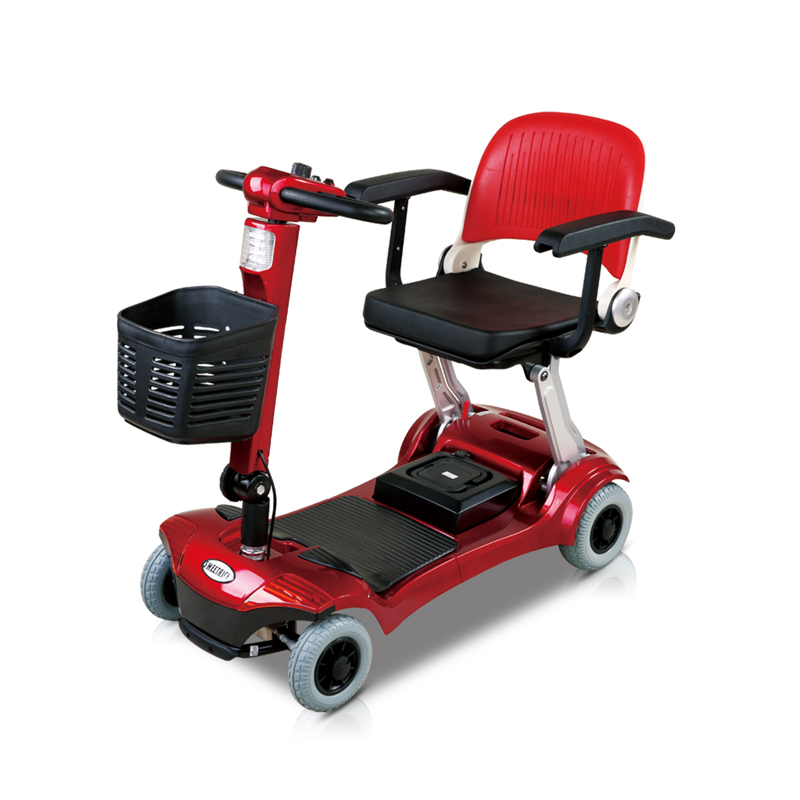
- 15 Product: SW 1000F Ready to ship mobility scooter 9 inch 4 wheels scooters

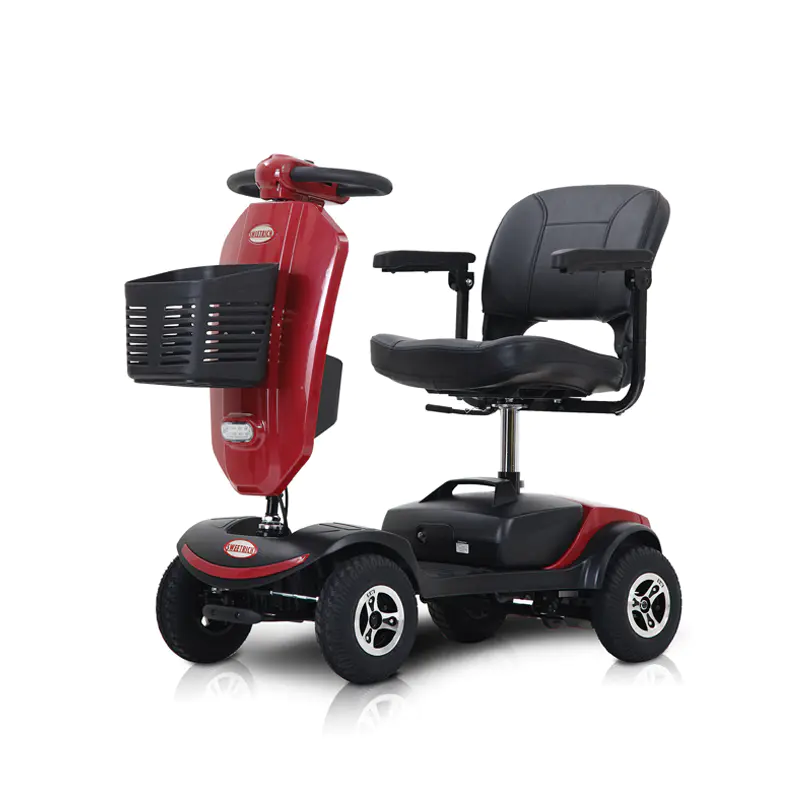
Choosing a mobility scooter requires more than comparing speed or appearance. A dependable scooter must balance portability, operating stability, battery performance, user capacity, braking safety, charging convenience, and everyday comfort. It should also be practical for storage, transportation, shopping trips, residential use, and other routine travel needs. The SW 1000F is designed as a compact four-wheel travel scooter for users who want straightforward electric mobility in a relatively small package.
With an overall size of 1000 x 525 x 920 millimeters, a maximum forward speed of 8 kilometers per hour, a stated driving range of 15 to 25 kilometers, and a weight capacity of 136 kilograms, this model is positioned for users who value maneuverability and convenient travel. Its lithium battery, electromagnetic braking system, Taiwan-sourced motor, and programmable motor controller provide a practical technical foundation for daily operation. The scooter also uses a 7-inch front tire and an 8-inch rear tire to support predictable movement on suitable paved surfaces.
This article examines the product in detail, explains its key advantages compared with many conventional travel scooters, and discusses how the manufacturer’s research, development, production management, and export experience support the product’s market position. Because the scooter is identified as a non-medical device for the United States market, it should be understood as a mobility transportation product rather than a medical treatment device. Users should follow applicable safety instructions and confirm that the scooter is appropriate for their individual needs and environment.
1. Product Overview
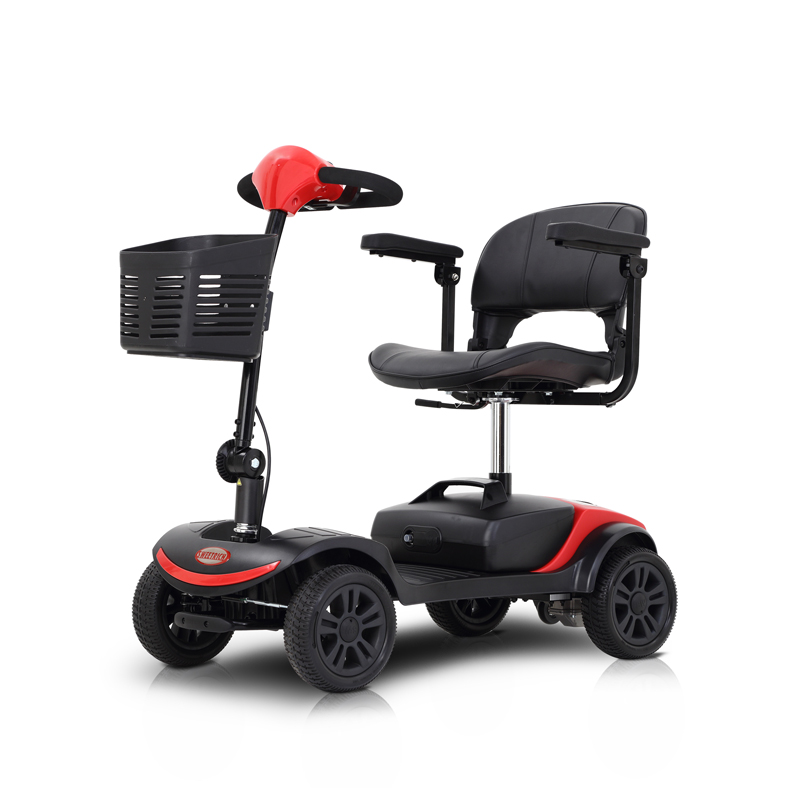
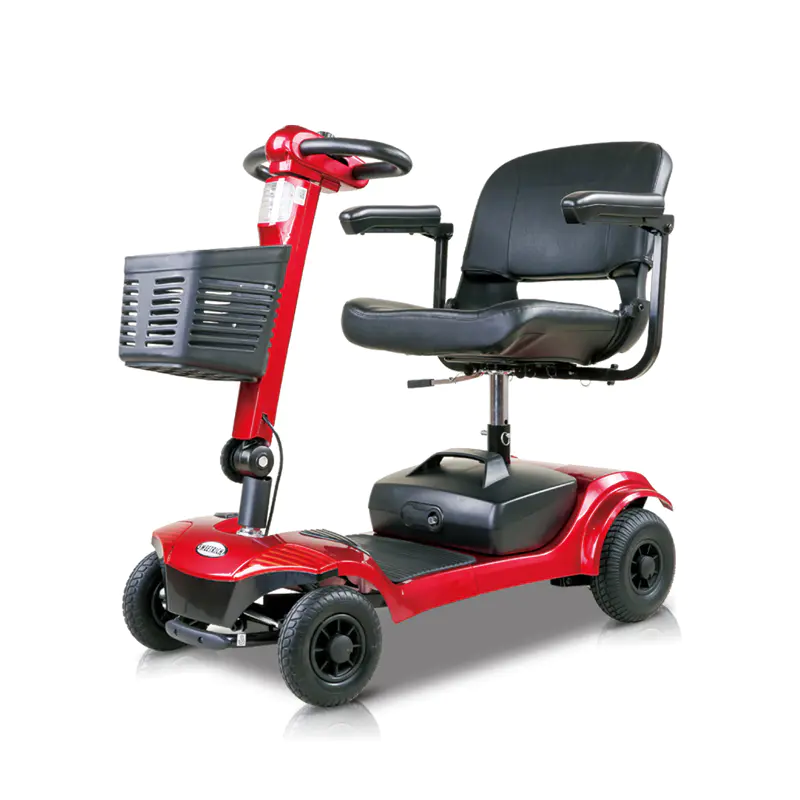
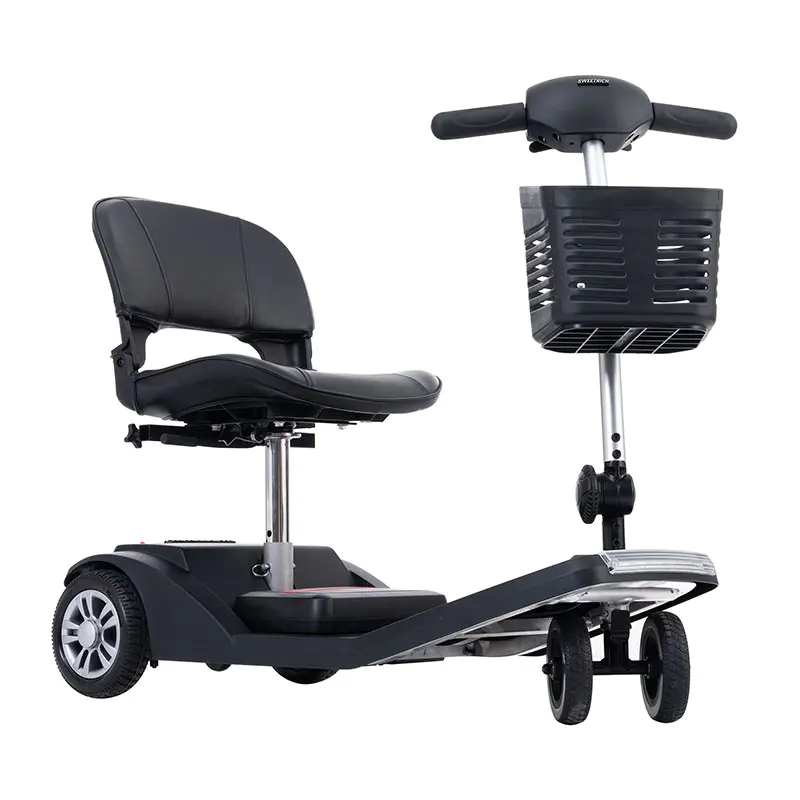
The SW 1000F is a four-wheel mobility scooter developed for travel-oriented use. Its compact proportions are among its most important features. At 1000 millimeters long and 525 millimeters wide, it is shorter and narrower than many full-size mobility scooters. This can make it easier to position in a home, move through suitable indoor spaces, place near a vehicle, or use in locations where a larger scooter may be inconvenient.
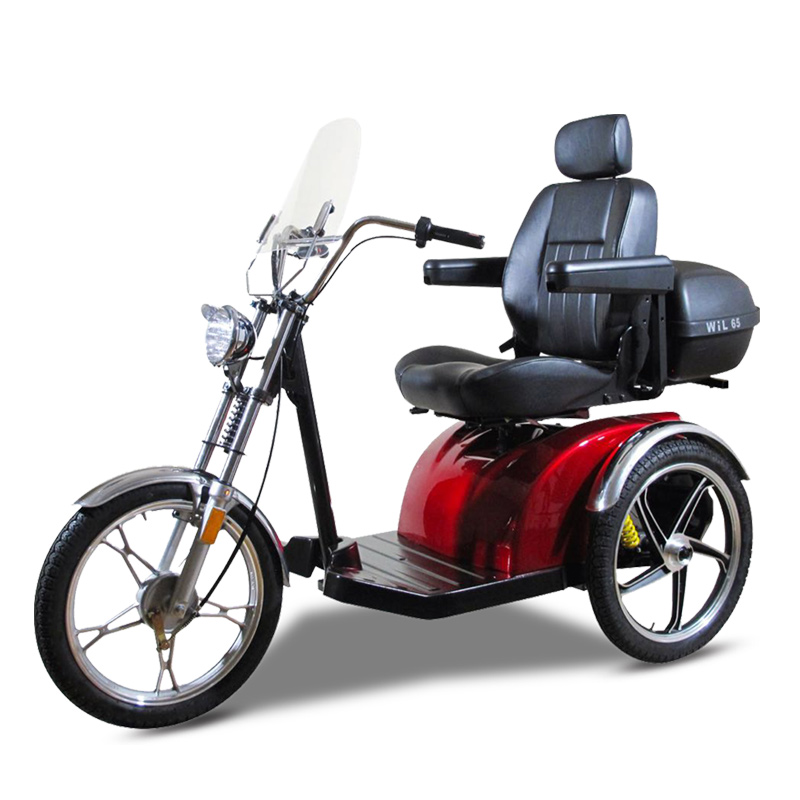
The four-wheel configuration offers a broader wheelbase than many three-wheel travel scooters. This design can provide a more balanced feeling during ordinary forward movement and turning. Four wheels may be especially appealing to users who prioritize a familiar, stable platform over the tighter turning circle sometimes associated with three-wheel models. As with all mobility equipment, the rider should operate at an appropriate speed and avoid slopes, uneven surfaces, and obstacles beyond the scooter’s rated conditions.
The scooter reaches a maximum forward speed of 8 kilometers per hour, equivalent to approximately 5 miles per hour. This is a practical speed for many low-speed travel situations, including movement around residences, paved paths, shopping areas, and other permitted environments. The stated maximum driving gradient is 10 degrees. Actual performance on a slope will depend on the rider’s weight, battery charge, surface condition, tire condition, temperature, and the direction and length of the incline.
The driving range is listed as 15 to 25 kilometers, or approximately 9.5 to 15.5 miles. A range expressed as a span is useful because real-world battery performance is affected by several variables. Heavier loads, frequent stopping and starting, rough pavement, inclines, cold temperatures, tire pressure, and aggressive acceleration can reduce the distance available from one charge. The published range should therefore be treated as a practical reference rather than a guarantee for every operating condition.
Specification |
SW 1000F Information |
Product type |
Four-wheel travel mobility scooter |
Overall dimensions |
1000 x 525 x 920 mm |
Maximum forward speed |
8 km/h or approximately 5 mph |
Maximum driving gradient |
10 degrees |
Driving range |
15–25 km or approximately 9.5–15.5 miles |
Weight capacity |
136 kg or 300 lb |
Front tire size |
7 x 2.5 inches |
Rear tire size |
8 x 3 inches |
Braking system |
Electromagnetic brake |
Battery |
Lithium 24 V / 20 Ah |
Charger |
DC 24 V, 2 A; AC 100–240 V input |
Charging time |
Approximately 8–10 hours |
Motor |
24 V / 270 W Taiwan motor |
Motor controller |
24 V / 50 A PG controller |
Heaviest part |
36.3 kg or 80 lb |
2. Compact Design for Everyday Travel
One of the clearest advantages of the SW 1000F is its compact footprint. Large mobility scooters can offer extra suspension travel, higher capacity, or longer range, but they may be difficult to store in a smaller home or transport in a standard vehicle. A compact travel scooter takes a different approach: it concentrates on essential mobility functions while keeping the external dimensions manageable.
The 525-millimeter width can be helpful when navigating suitable doorways, corridors, store aisles, and other confined spaces. Users should always measure their own doorways and planned routes before purchase, because clearances vary by building and environment. Nevertheless, a narrow body generally gives a travel scooter a practical advantage over wider outdoor models in indoor and mixed-use settings.
The 1000-millimeter length also supports a relatively small turning footprint. While the product information does not provide a formal turning radius, a shorter chassis can make positioning more convenient than with a long-wheelbase scooter. This may be useful when approaching a table, turning near a counter, entering an elevator, or aligning the scooter with a vehicle storage area.
The scooter’s 920-millimeter height contributes to a low-profile travel-oriented design. This can make it easier to place under suitable storage arrangements, although the actual available height must be measured carefully. Storage should be dry, clean, and protected from extreme temperatures. The scooter should not be stored in a position that could place stress on controls, wiring, or the steering assembly.
The heaviest part is listed at 36.3 kilograms, or 80 pounds. This specification is important when evaluating vehicle transport and handling. The product may be more manageable than a single-piece full-size scooter, but 80 pounds is still substantial for many individuals. Loading should be performed with proper assistance, an appropriate ramp or lifting device, and a vehicle arrangement designed for the scooter’s weight. The heaviest-part figure should not be interpreted as a promise that every user can safely lift it alone.
Travel-oriented benefits
The SW 1000F is well suited to buyers who place value on the following characteristics:
First, its compact dimensions can simplify storage and maneuvering in locations designed for ordinary household movement. Second, its four-wheel platform provides a familiar layout for users who prefer not to use a three-wheel configuration. Third, its lithium battery offers a modern energy-storage format in a 24-volt system. Fourth, the universal AC input specification of 100–240 volts gives the charger broad input compatibility, subject to the proper electrical connection and local requirements.
These features make the scooter a practical candidate for local errands and planned outings. It may be used for travel on appropriate paved surfaces, at permitted locations, and in accordance with local rules. Its compact form does not mean that it is intended for every terrain. Buyers seeking extensive outdoor use, rough-ground performance, or especially long-distance travel may require a larger model with additional suspension and a different battery configuration.
SW 1000F Ready to ship mobility scooter 9 inch 4 wheels scooters
3. Four-Wheel Configuration and Ride Confidence
Wheel layout has a major effect on how a mobility scooter feels during everyday operation. The SW 1000F uses four wheels rather than three. The additional front wheel can create a broader support arrangement and may provide a reassuring sense of balance during ordinary travel. This can be particularly valuable for users who prefer predictable movement while driving at a moderate speed.
Four-wheel scooters are often selected for general-purpose stability, but they may have a slightly wider turning path than comparable three-wheel models. The SW 1000F addresses the space challenge through its compact 1000-millimeter length and 525-millimeter width. This combination is intended to preserve much of the convenience expected from a travel scooter without relying on a three-wheel layout.
The front tires measure 7 by 2.5 inches, while the rear tires measure 8 by 3 inches. The different front and rear dimensions are consistent with the functional roles of each axle. Front wheels guide the scooter, while rear wheels support the drive system and transmit motor power. The tire specification should be considered when planning maintenance, replacement, and operation on different surfaces.
The product information does not list a suspension system. This means buyers should have realistic expectations about ride comfort on uneven terrain. The scooter is better matched to smooth or reasonably maintained paved surfaces than to rough trails, deep cracks, loose gravel, or heavily uneven ground. Users can improve ride quality and operating safety by selecting suitable routes, reducing speed on imperfect pavement, and avoiding obstacles that exceed the scooter’s clearance or stability limits.
Why four wheels can be an advantage over some alternatives
Compared with some compact three-wheel scooters, a four-wheel design may offer a more confidence-inspiring base during straight travel and low-speed maneuvering. Compared with large four-wheel outdoor scooters, the SW 1000F is easier to position in smaller spaces because of its reduced overall dimensions. It therefore occupies a useful middle ground: more compact than many outdoor models while offering the four-wheel format preferred by many users.
Each configuration involves trade-offs. A three-wheel scooter may be favored for its tight turning capability, while a larger four-wheel scooter may provide stronger outdoor capability and more cushioning. The SW 1000F is designed around compact travel, not maximum off-road performance. Its advantage is the balance among footprint, wheel count, operating speed, capacity, and electrical efficiency.
4. Power System and Battery Performance
The scooter uses a 24-volt, 20-ampere-hour lithium battery. Lithium battery technology is widely valued for its energy density and practical weight characteristics. In a travel scooter, battery mass affects transport, handling, and total product weight. A lithium configuration can support a more compact product concept while providing energy for local travel.
The stated range of 15 to 25 kilometers gives users a useful planning reference. The lower end may be more realistic when the scooter is carrying a heavier load, traveling over gradients, operating in cold conditions, or stopping frequently. The upper end may be approached under favorable conditions, such as a lighter load, smooth pavement, moderate temperatures, properly maintained tires, and steady operation.
Battery planning is an important part of responsible scooter use. A rider should allow a reserve rather than planning a route that exactly matches the maximum published range. The battery should be charged according to the supplied charger instructions, and users should avoid allowing the battery to remain fully depleted for extended periods. The charging location should be dry, ventilated, and free from combustible materials.
The charger is specified as DC 24 V, 2 A, with AC 100–240 V input. This broad input range is helpful for international distribution because it accommodates common mains-voltage environments when used with the correct plug arrangement and local electrical practices. The stated charging time is 8 to 10 hours. Overnight charging may be convenient for many users, but charging should always follow the manufacturer’s instructions and any applicable battery-safety guidance.
Battery advantages in a travel product
A lithium battery can contribute to the scooter’s travel-oriented design in several ways. It can help reduce the need for a very large battery compartment, support a cleaner packaging layout, and provide a useful balance between range and compactness. It may also be easier to integrate into a product that must be stored or transported in sections.
However, battery type alone does not determine real-world performance. The motor, controller, tire condition, rider weight, terrain, and manufacturing quality all influence efficiency. The SW 1000F combines the 24-volt lithium battery with a 270-watt motor and a 50-ampere PG controller. This combination is intended to deliver controlled low-speed propulsion appropriate to the scooter’s maximum rated speed and travel application.
Battery replacement should be handled by qualified personnel or according to the supplier’s service process. Lithium batteries require appropriate handling, packaging, storage, and disposal. Buyers should confirm replacement availability, warranty terms, and local transport requirements before purchasing.
5. Motor, Controller, and Braking System
The SW 1000F uses a 24-volt, 270-watt motor identified as a Taiwan motor. Motor selection influences acceleration, climbing ability, energy use, noise, and long-term reliability. A 270-watt motor is consistent with a compact travel scooter designed for moderate-speed operation rather than high-performance outdoor driving.
The maximum speed is limited to 8 kilometers per hour. A controlled speed range can make the scooter easier to manage in pedestrian environments and confined spaces. Riders should still maintain a safe speed, particularly near people, corners, entrances, ramps, wet surfaces, and areas with limited visibility.
The motor controller is specified as a 24-volt, 50-ampere PG controller. The controller regulates the electrical relationship between the battery, accelerator input, and motor. A quality controller can contribute to smooth starting, controlled acceleration, and consistent response. It also provides a foundation for integrating protective functions and operating logic into the electrical system.
The electromagnetic brake is another significant feature. Electromagnetic braking systems are commonly used in electric mobility products because they can engage when the drive control is released or power is interrupted, depending on the system design. This provides an important layer of controlled stopping support. The brake should not be treated as a substitute for careful driving, route planning, or regular inspection.
Users should test the brake response in a safe, open area before regular operation. If the scooter does not stop as expected, makes unusual noises, rolls when the control is released, or behaves inconsistently, it should not be used until inspected. The braking system, tires, electrical connectors, and control functions should be included in routine maintenance.
Electrical integration as a competitive strength
Many entry-level travel scooters compete primarily on price or appearance. A more meaningful comparison considers how the motor, controller, battery, and braking system work together. The SW 1000F presents a coordinated 24-volt architecture, with a lithium battery, 270-watt motor, 50-ampere controller, and electromagnetic brake. This coherent system design can be an advantage over products that use poorly matched or inconsistently documented components.
The value of an integrated system is especially visible in everyday usability. Smooth power delivery can make starting and stopping less stressful. Consistent control response can make indoor maneuvering more predictable. A properly coordinated brake system can contribute to confidence when the rider releases the control. These benefits depend on correct assembly, quality testing, and appropriate maintenance, which is why manufacturing processes are as important as the published specifications.
6. Capacity, Comfort, and User Considerations
The rated weight capacity is 136 kilograms, or 300 pounds. This rating should include the rider and any carried items, such as shopping bags or personal equipment. Users should avoid exceeding the specified capacity because additional load can affect acceleration, braking distance, climbing ability, battery range, tire wear, and overall stability.
Capacity is one of the areas where the SW 1000F can compare favorably with some smaller travel scooters. A compact product does not necessarily need to have a very low weight rating. The 300-pound capacity provides practical flexibility for a broad range of users, while the scooter remains significantly smaller than many heavy-duty outdoor models.
Comfort depends on more than seat dimensions. It is influenced by the riding position, handlebar arrangement, steering response, tire design, surface condition, and the duration of each trip. Because the specifications do not provide detailed seat measurements or identify a suspension system, prospective buyers should evaluate the seating arrangement directly where possible. They should also consider whether the control layout is comfortable and whether they can safely reach and operate the controls.
The scooter’s lack of listed suspension makes route selection especially important. Smooth pavement can provide a more comfortable experience than broken sidewalks or uneven ground. Riders should reduce speed when crossing thresholds or changes in surface level, approach obstacles straight on when appropriate, and avoid sudden steering movements.
Who may benefit from the design?
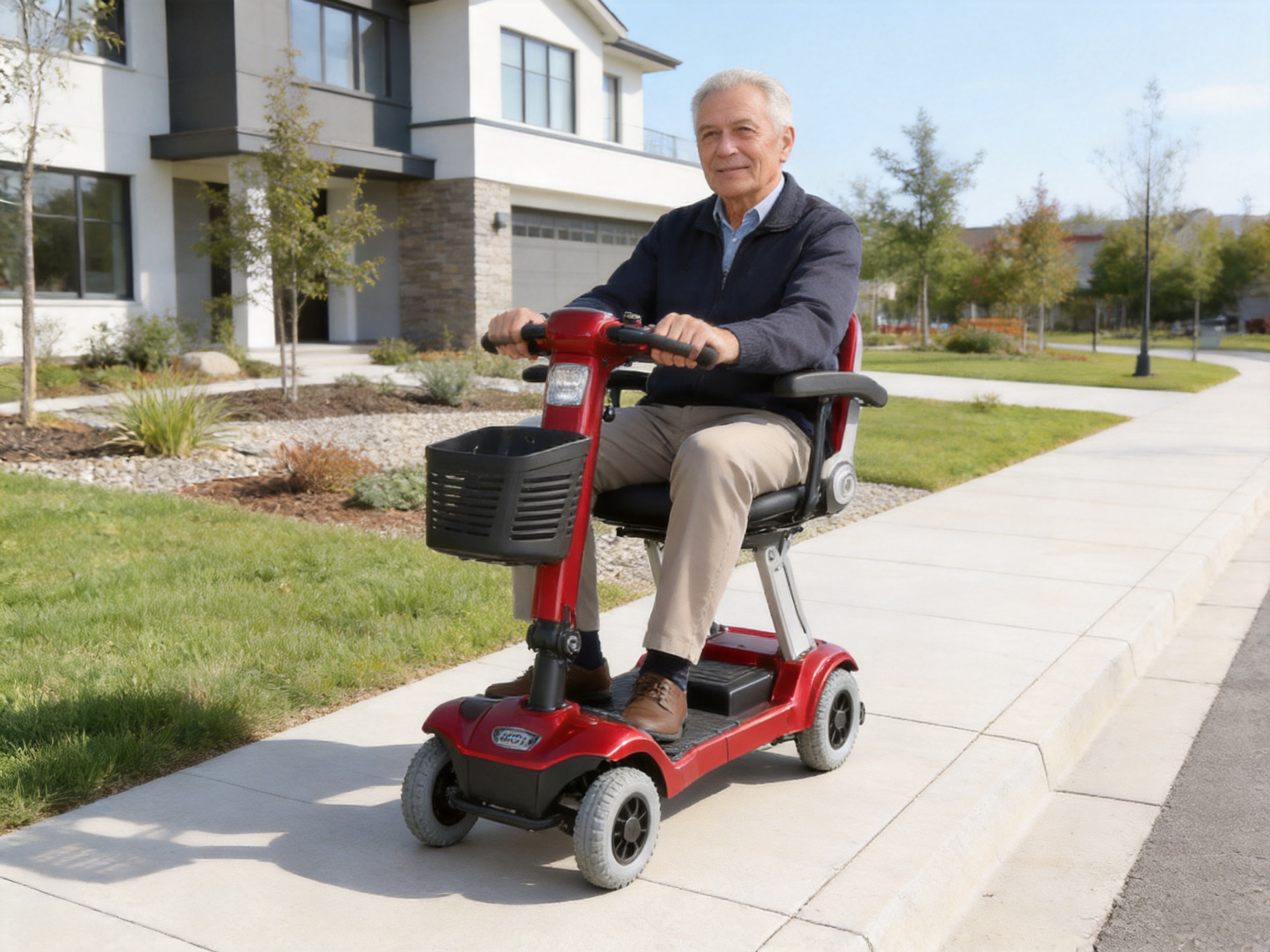
The SW 1000F may appeal to adults who need a compact electric mobility option for local travel and who can safely operate a scooter. It may be suitable for users who value a four-wheel platform, moderate range, a 300-pound capacity, and a relatively small storage footprint.
It may also suit families, retailers, rental operators, and distributors seeking a travel-oriented model that is easier to explain and position than a highly specialized outdoor scooter. The combination of basic specifications, lithium power, electromagnetic braking, and four-wheel construction creates a straightforward product story for the mobility market.
It may be less suitable for buyers who need a high-speed road vehicle, extended all-day range, advanced suspension, very high ground clearance, or a heavy-duty capacity beyond 300 pounds. It is also not a medical treatment device. Buyers should consider their physical abilities, local regulations, intended routes, storage arrangements, and transportation method before purchase.
7. Manufacturing Strengths and Product Development
The manufacturer is a high-tech company based in Suzhou Industrial Zone, Jiangsu, China. Established in 2011, it has accumulated more than ten years of experience in researching, developing, and producing mobility scooters and power wheelchairs. This experience is relevant because mobility products require the integration of mechanical structure, electrical systems, user ergonomics, battery technology, quality management, and international market requirements.
The company operates a factory covering approximately 30,000 square meters on a site of about 60 acres. A facility of this scale can support organized production planning, dedicated assembly areas, component management, testing processes, warehouse operations, and product development activities. Factory size alone does not guarantee quality, but it can provide the physical infrastructure needed for repeatable manufacturing and controlled workflow.
The company’s focus on intellectual property for electric scooters and power wheelchairs indicates an emphasis on product development rather than simple trading or resale. Proprietary design work can help a manufacturer refine frame geometry, control systems, battery packaging, user interfaces, and assembly methods. It can also support product differentiation in a competitive international market.
The manufacturer states that its products are designed to improve convenience and independence for elderly and disabled users. This objective is reflected in the SW 1000F’s compact dimensions, low-speed control, four-wheel layout, and travel-focused configuration. Product design for mobility equipment should always consider the user’s ability to enter, sit, steer, accelerate, brake, charge, and store the device safely.
Research and development approach
Effective research and development in the mobility sector requires more than selecting a motor and adding a seat. Engineers must consider frame strength, load distribution, wheel placement, turning behavior, battery protection, wiring routes, controller compatibility, brake response, and service access. They must also consider how a product will be assembled repeatedly and inspected before shipment.
The manufacturer’s stated experience in electric scooters and power wheelchairs provides an established base for this work. The company describes its products as incorporating advanced control technology and driving systems to support smooth and safe operation. In the SW 1000F, the motor controller and electromagnetic brake are central parts of this system architecture.
Product development also includes adapting products for different markets. A scooter intended for international distribution must account for charger input ranges, labeling, packaging, documentation, electrical expectations, and customer service requirements. The SW 1000F charger’s 100–240-volt AC input is a practical example of a specification that supports broad market compatibility, subject to the proper local configuration.
8. Production Management and Quality Focus
The company describes its production philosophy as based on strict production management and scientific product design. In practical terms, a quality-oriented mobility scooter production process should include incoming inspection of critical components, controlled assembly procedures, electrical checks, brake verification, battery-system inspection, and final functional testing.
Incoming inspection may cover motors, controllers, batteries, chargers, tires, frames, steering components, and fastening hardware. Critical electrical parts should correspond with the product’s designed voltage and current requirements. Mechanical parts should be checked for dimensions, finish, fit, and damage. These steps help reduce variation before assembly begins.
During assembly, wiring should be routed to reduce abrasion, pinching, and unnecessary exposure to movement or heat. Fasteners should be installed with suitable procedures, and steering or brake components should be checked for correct alignment. Battery connections should be secure and protected. A repeatable assembly process improves consistency between units.
Functional testing is particularly important for mobility scooters because the product directly controls movement. A complete test program may include forward and reverse operation, acceleration response, steering, electromagnetic brake engagement, charger connection, battery indicators, controller response, and basic load verification. The exact factory test procedures are not provided in the product information, but these are important categories for a responsible manufacturer to manage.
Final inspection can help confirm that the scooter is correctly configured before packaging. It may include checking dimensions, accessories, labels, fasteners, cosmetic condition, charger specifications, and user documentation. Careful packaging is also essential because the scooter may experience vibration and handling during international transportation.
Why manufacturing quality matters to buyers
Two scooters with identical headline specifications may deliver different ownership experiences if they differ in assembly quality, component consistency, documentation, or after-sales support. A well-managed factory can provide greater confidence that each unit follows the intended design. It can also make it easier to trace production issues, manage replacement parts, and improve future product versions.
The manufacturer’s export experience is another relevant strength. Its products are reported to reach markets in America, Europe, Japan, Australia, the Middle East, Russia, and other regions. International distribution requires familiarity with varied customer expectations, shipping requirements, local market practices, and communication needs. This experience can support distributors seeking a supplier with a broader understanding of global mobility-product sales.
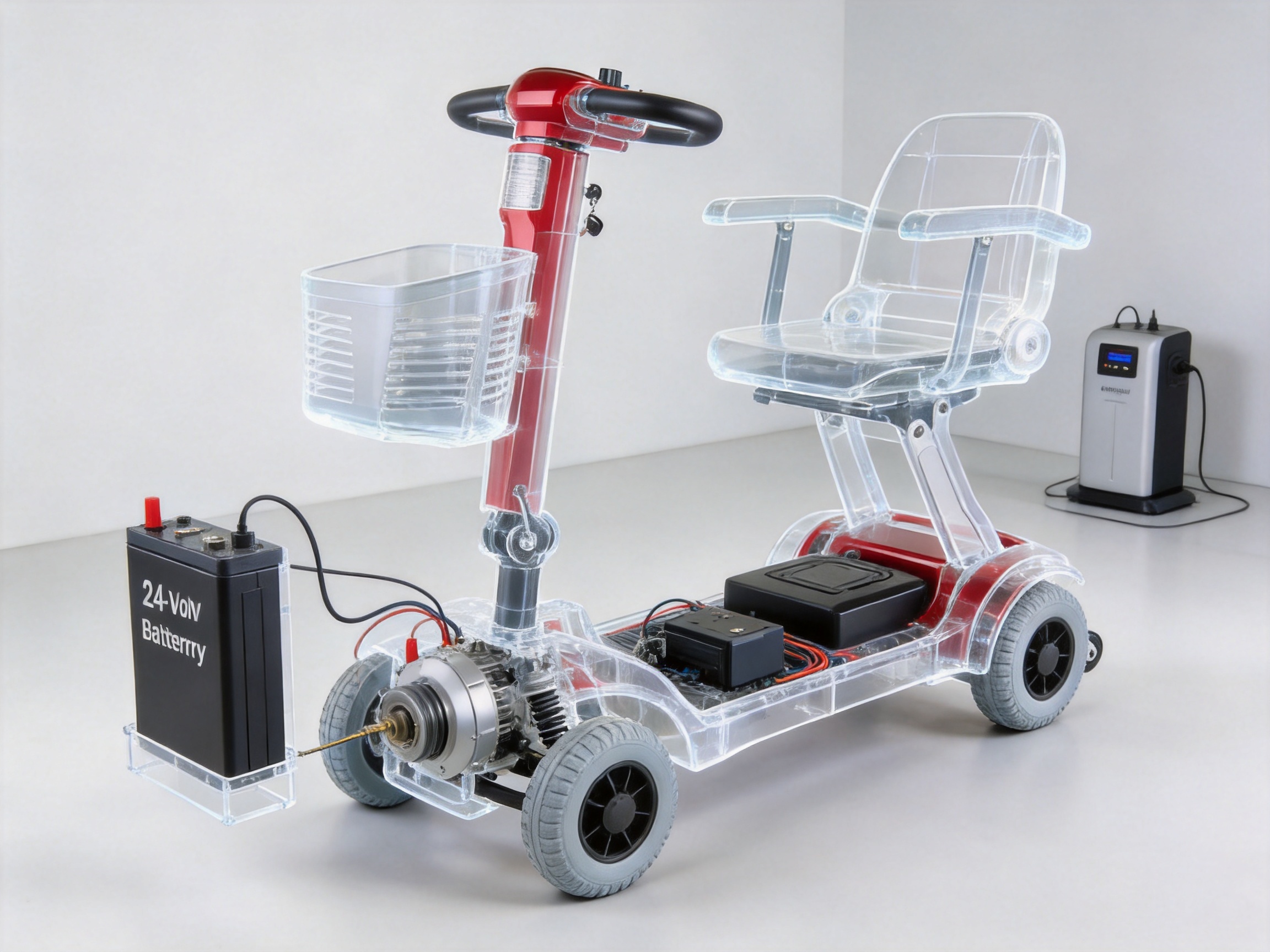
9. Advantages Compared with Competing Travel Scooters
The SW 1000F competes in a segment that includes three-wheel scooters, larger four-wheel scooters, folding models, and basic portable electric mobility products. Its most important advantage is not one isolated specification but the way several practical features are combined.
Compact dimensions with four-wheel stability
Many compact scooters use three wheels to achieve a tight turning circle. The SW 1000F instead retains four wheels while keeping its length and width relatively compact. This gives buyers an alternative to the usual three-wheel travel format. Users who prefer four contact points with the ground may find this arrangement more reassuring for ordinary paved travel.
Useful capacity in a smaller frame
A 300-pound weight capacity is meaningful in a compact travel category. Some very small scooters prioritize minimal size at the expense of user capacity. The SW 1000F offers a balance that may serve a wider group of users while remaining shorter and narrower than many full-size models.
Lithium battery technology
The 24-volt, 20-ampere-hour lithium battery supports the scooter’s travel-oriented concept. Lithium power can help reduce the burden associated with some traditional battery formats and may support efficient packaging. Buyers should still evaluate battery service and replacement arrangements, but the technology is a strong point in the product specification.
Internationally compatible charger input
The AC 100–240-volt input specification provides flexibility for international markets. This can simplify distribution and use across regions when the appropriate plug and local electrical practices are applied. It is a practical advantage over products designed around a narrower input range.
Recognized electrical components
The Taiwan motor and PG motor controller are identified in the technical information. Naming important components improves product transparency and allows buyers and distributors to compare systems more meaningfully. The 270-watt motor and 50-ampere controller are matched to the scooter’s low-speed travel purpose and 24-volt electrical platform.
Manageable transport planning
The heaviest part is listed as 80 pounds. While not lightweight for every person, this information allows buyers to plan realistic transportation requirements. It is preferable to have a clearly stated heaviest-part specification rather than discover only after purchase that the scooter cannot be loaded safely into a vehicle.
10. Operation, Safety, and Maintenance Guidance
Before operating the scooter, the user should read all supplied instructions and become familiar with the controls in a safe, open area. The rider should check the battery charge, tire condition, steering response, brake operation, and general condition of the scooter. Any loose component, damaged cable, unusual noise, or control problem should be addressed before travel.
The scooter should be driven at a speed appropriate to the environment. A maximum speed of 8 kilometers per hour is not a required operating speed. Lower speeds are appropriate near pedestrians, in narrow corridors, on slopes, around corners, and on surfaces with limited traction. Riders should maintain a safe distance from obstacles and allow adequate stopping space.
Although the maximum driving gradient is listed as 10 degrees, users should approach slopes carefully. A gradient rating does not mean that every slope is safe under every condition. Surface texture, wetness, loose material, cross-slope angle, load, battery level, and direction of travel can affect performance. Riders should avoid slopes that create a risk of tipping or loss of control.
Water exposure should be minimized. The scooter should not be driven through deep water, heavy flooding, or conditions that could expose the battery, controller, motor, or electrical connectors to damaging moisture. After use in damp conditions, the scooter should be dried appropriately and inspected.
Routine maintenance may include checking tire wear, inspecting fasteners, cleaning the frame, examining wiring, confirming charger condition, and testing the braking response. Tires should be replaced when worn or damaged. The battery should be charged and stored according to the manufacturer’s instructions. Unauthorized modifications may affect safety, performance, warranty coverage, and compliance with local requirements.
Transport and storage
When transporting the scooter in a vehicle, it should be secured against movement. The user should verify the vehicle’s load capacity and use suitable ramps, tie-down systems, or mobility equipment. The 80-pound heaviest-part specification is useful for planning, but the full scooter and any separated components must be handled safely.
Storage should protect the scooter from rain, excessive heat, freezing conditions, and direct exposure to damaging chemicals. The charger should be kept in a dry location, and the battery should not be handled with wet hands or damaged tools. If the scooter will not be used for an extended period, the user should follow the recommended long-term battery-storage procedure.
11. Buying Guidance for Distributors and End Users
Retailers and distributors should present the SW 1000F according to its actual strengths. It is a compact, four-wheel travel scooter with a moderate range, 5-mile-per-hour maximum speed, lithium battery, electromagnetic brake, and 300-pound capacity. It should not be marketed as a high-performance off-road scooter or as a medical treatment device.
Distributors should confirm the availability of spare batteries, chargers, tires, controllers, brake components, and other service parts. They should also clarify warranty terms, technical support procedures, user documentation, and packaging information. A strong product is easier to sell and support when the supplier provides accurate technical details and responsive communication.
End users should measure their storage area, doorways, vehicle access, and intended routes. They should assess whether the 80-pound heaviest part can be managed safely and whether a ramp or lifting aid is required. They should also consider whether the 15-to-25-kilometer range is sufficient for their normal trips with a reasonable reserve.
Personal fit is equally important. Buyers should consider seating comfort, steering reach, control operation, visual access, transfer ability, and the ability to charge the battery safely. If the user has physical or balance limitations, professional advice may be appropriate before purchase. A compact scooter can be useful, but it must match the user’s abilities and intended environment.
12. Frequently Asked Questions
What type of product is the SW 1000F?
The SW 1000F is a compact four-wheel electric mobility scooter intended for travel-oriented use. It is identified as a non-medical device for the United States market. It is designed for suitable low-speed mobility applications rather than medical treatment.
What is the maximum speed?
The maximum forward speed is 8 kilometers per hour, or approximately 5 miles per hour. Actual operating speed should be adjusted to the rider, route, surface, visibility, and local rules.
How far can it travel on one charge?
The stated driving range is 15 to 25 kilometers, or approximately 9.5 to 15.5 miles. Actual range depends on rider weight, terrain, slope, temperature, battery condition, tire condition, stopping frequency, and driving style.
What is the weight capacity?
The rated weight capacity is 136 kilograms, or 300 pounds. This figure includes the rider and carried items. Exceeding the rating may affect braking, stability, range, and mechanical performance.
Does the scooter use a lithium battery?
Yes. The product information specifies a 24-volt, 20-ampere-hour lithium battery. Charging and storage should follow the supplied instructions and applicable battery-safety practices.
How long does charging take?
The listed charging time is approximately 8 to 10 hours. Charging time can vary depending on battery condition, charger behavior, temperature, and the remaining battery level.
What charger input does the scooter support?
The charger is specified with AC 100–240-volt input and DC 24-volt, 2-ampere output. The correct plug arrangement and local electrical practices must be used.
Does the scooter have electromagnetic braking?
Yes. The SW 1000F uses an electromagnetic brake system. The brake should be tested regularly, and the scooter should not be operated if braking behavior is abnormal.
Is the scooter suitable for rough outdoor terrain?
The product is designed as a travel scooter, and no suspension system is listed. It is best suited to suitable paved or reasonably smooth surfaces. Users should avoid rough ground, deep cracks, loose gravel, flooding, and obstacles that may exceed the scooter’s capabilities.
Is the four-wheel design better than a three-wheel design?
Neither design is universally better. Four wheels may provide a more balanced and stable feeling, while three wheels may offer a tighter turning circle. The SW 1000F is intended for buyers who prefer a compact four-wheel platform.
How heavy is the largest individual part?
The heaviest part is listed as 36.3 kilograms, or 80 pounds. This can assist with transport planning, but many users may still require help, a ramp, or a lifting device.
Who manufactures the product?
The product is manufactured by Suzhou Sweetrich Vehicle Industry Technology Co., Ltd., a Suzhou-based company established in 2011. The company develops and produces mobility scooters and power wheelchairs and exports products to multiple international markets.
What should buyers verify before ordering?
Buyers should verify dimensions, capacity, range expectations, battery and charger details, warranty terms, spare-part availability, delivery packaging, local operating rules, and the ability to store and transport the scooter safely.
13. Conclusion
The SW 1000F is a practical compact mobility scooter built around a clear travel-focused concept. Its 1000 x 525 x 920-millimeter dimensions make it easier to consider for storage and maneuvering than many larger scooters. Its four-wheel layout provides an alternative to compact three-wheel designs, while the 300-pound capacity offers useful flexibility for a travel model.
The 8-kilometer-per-hour maximum speed, 15-to-25-kilometer stated range, 24-volt lithium battery, electromagnetic brake, 270-watt motor, and PG controller create a balanced electrical and mechanical package for local mobility. The 100–240-volt charger input adds international practicality, and the clearly stated 80-pound heaviest-part specification helps buyers plan transportation realistically.
The product’s value is further supported by the manufacturer’s development and production background. More than a decade of industry experience, a substantial factory facility, intellectual-property activity, international export experience, and an emphasis on production management provide a meaningful foundation for product consistency and supplier support.
As with any mobility scooter, the best choice depends on the user’s body size, abilities, routes, climate, storage arrangements, and transportation needs. The SW 1000F is not intended to replace every type of mobility product. Its strongest position is as a compact four-wheel travel scooter for users who want a manageable footprint, moderate range, lithium power, and practical everyday performance on suitable surfaces.
References
1. Product specification sheet for the SW 1000F four-wheel travel mobility scooter.
2. Manufacturer-provided company profile and production information for Suzhou Sweetrich Vehicle Industry Technology Co., Ltd.
3. General principles of electric mobility scooter operation, battery charging, maintenance, and safe storage.
4. General guidance concerning mobility-device route planning, load capacity, braking inspection, and responsible low-speed operation.
5. General engineering considerations for lithium battery systems, electric motor controllers, electromagnetic braking systems, and compact mobility equipment.