
 +86-(0)512-82283871
Content
- 1 Why Battery Range Matters for Mobility Scooters
- 2 Battery Capacity Is Only One Part of Range
- 3 More Efficient Motors Can Reduce Energy Consumption
- 4 Controller Calibration Also Affects Efficiency
- 5 Reducing Scooter Weight Can Improve Range
- 6 Tire Design Influences Rolling Resistance
- 7 Battery Chemistry Affects Charging and Service Life
- 8 Battery Management Systems Help Control Charging
- 9 Charging Speed Needs to Be Balanced With Battery Requirements
- 10 Smart Charging Features Can Support Fleet Operation
- 11 Thermal Management Affects Battery Performance
- 12 Regenerative Braking Has Limited but Useful Potential
- 13 Charging Convenience Can Be Improved Through Battery Design
- 14 Range Claims Should Be Based on Defined Conditions
- 15 What Should B2B Buyers Ask Mobility Scooter Manufacturers?
- 16 Custom Battery Solutions for Different Scooter Applications
- 17 Improving Range Requires a Complete-System Approach
Battery performance has become a pretty important part of mobility scooter design. For users, a scooter with enough usable range means fewer worries about charging halfway through the day. For distributors, retailers, and mobility equipment buyers, battery performance also affects how the product is sold, how often batteries need attention, and whether customers are happy with the scooter after they buy it.
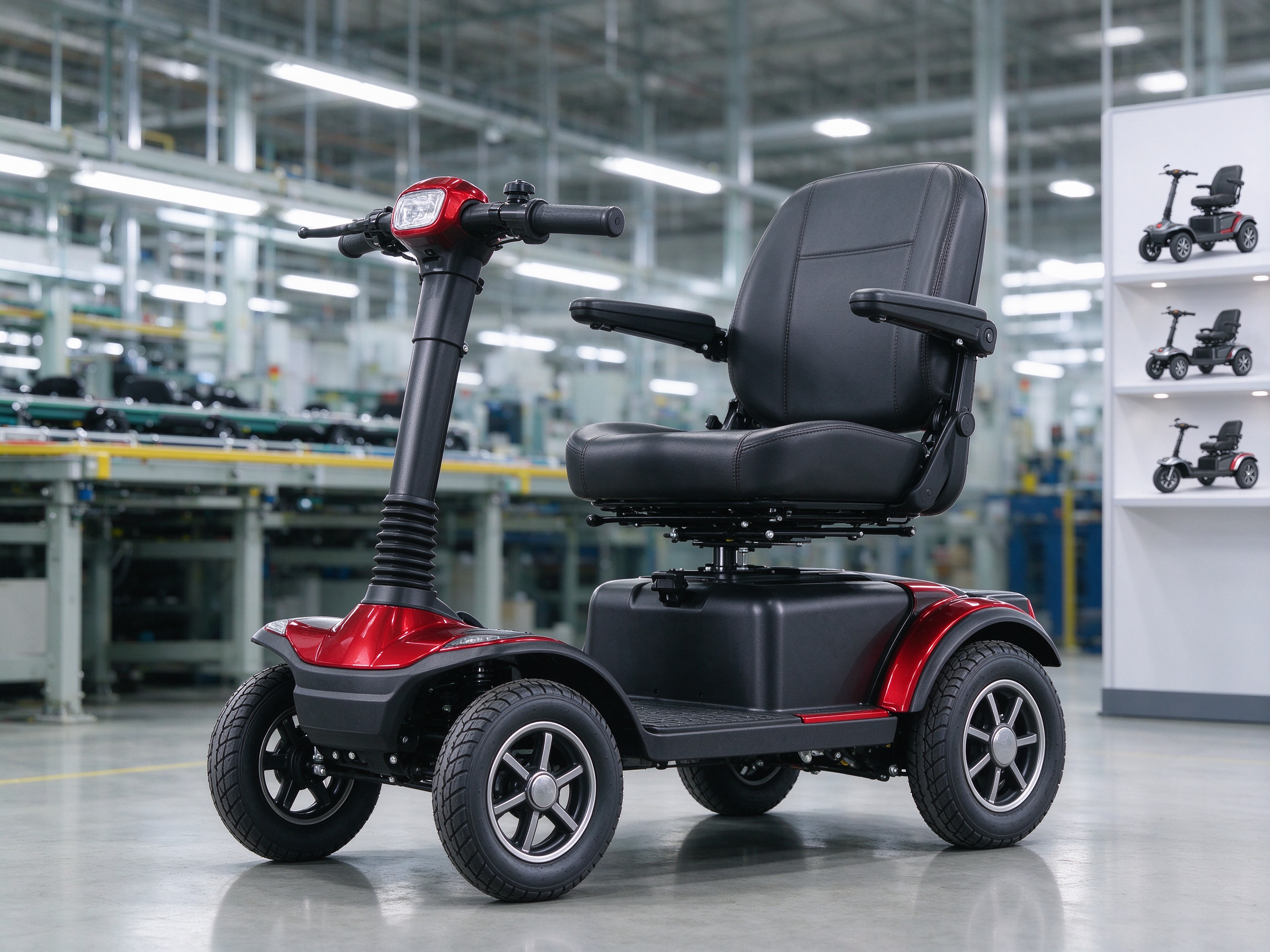
Mobility scooters are now used for shopping, community trips, outdoor activities, and everyday transportation. Because of that, Mobility Scooter Manufacturers are looking at more than simply adding a bigger battery. Motor efficiency, controller settings, tire choice, scooter weight, battery chemistry, and charging systems all come into play.
A larger battery can provide more stored energy, but it also adds weight. That extra weight then requires more energy to move. So the real challenge is finding a setup where the battery, motor, and rest of the scooter work well together.
Why Battery Range Matters for Mobility Scooters
Battery range is usually described as the distance a scooter can travel after a full charge under certain test conditions.
In everyday use, that number can change. A heavier rider, steep roads, cold weather, low tire pressure, an older battery, or lots of stopping and starting can all reduce the distance the scooter can cover.
For B2B buyers, it is worth asking how the manufacturer got the advertised range instead of looking at the number by itself.
| Factor | Possible effect on range |
|---|---|
| Rider weight | Higher loads can increase energy use |
| Terrain | Hills generally require more power |
| Riding speed | Higher speeds can use more energy |
| Temperature | Cold conditions can affect battery performance |
| Tire pressure | Incorrect pressure can increase rolling resistance |
| Battery age | Available capacity decreases over time |
| Stop-and-go use | Repeated acceleration can use more energy |
A supplier that gives clear testing conditions makes it much easier to compare different scooters.
Battery Capacity Is Only One Part of Range
Battery capacity is normally given in watt-hours (Wh).
The basic calculation is:
Battery energy (Wh) = Voltage (V) × Capacity (Ah)
For example, a 24 V battery with a capacity of 20 Ah has a nominal energy rating of 480 Wh.
That does not mean the scooter will use all 480 Wh to drive. Some energy is affected by battery management, electrical losses, motor efficiency, operating conditions, and other parts of the system.
This is why two scooters with similar battery ratings can still provide different real-world ranges.
For manufacturers, improving the efficiency of the whole power system can sometimes add useful range without simply increasing battery size.
More Efficient Motors Can Reduce Energy Consumption
The motor naturally has a big influence on how much energy a scooter uses.
Motor selection affects acceleration, cruising, hill climbing, and overall power consumption. Many mobility scooters use brushless DC motors because they suit electric drive systems and generally require relatively little maintenance.
Still, the motor needs to match the scooter.
A small scooter intended mainly for indoor use does not have the same requirements as a larger outdoor model carrying a heavier rider over longer distances.
Mobility Scooter Manufacturers can improve efficiency by choosing motor output based on the actual load, speed, and terrain the scooter is expected to handle.
Controller Calibration Also Affects Efficiency
The controller decides how electrical power reaches the motor, so its settings can make a difference to battery use.
Acceleration response, current limits, speed settings, and other control parameters all affect how the scooter behaves.
For example, a scooter that takes off very aggressively can draw a lot of current during acceleration. A smoother response may use energy more efficiently in some situations and can also make the scooter easier to control.
The controller should be tested together with the motor and battery. Changing one without checking the others can change the way the whole drive system behaves.
Reducing Scooter Weight Can Improve Range
A lighter scooter generally needs less energy to accelerate and move, assuming the other conditions are the same.
That sounds simple, but there are limits. The scooter still needs to support the intended rider and deal with normal road conditions.
Manufacturers may reduce weight through:
- Aluminum or other lightweight structural materials
- More compact battery packaging
- Optimized frame geometry
- Lighter seats and components
- More efficient motor construction
The goal is not simply to make the scooter as light as possible. It still needs to feel stable and handle the expected rider load properly.
Tire Design Influences Rolling Resistance
Tires are another small detail that can have a real effect on energy consumption.
Rolling resistance depends on the tire material, size, construction, pressure, tread, road surface, and load.
Wheel size can also affect how the scooter deals with uneven ground. Pneumatic and solid tires have different characteristics, so the choice should fit the application.
For B2B buyers, it is useful to ask for the recommended tire pressure when pneumatic tires are used. The manufacturer should also be able to explain what type of riding environment the tire setup is intended for.
A scooter used mostly inside buildings may need a different setup from one that spends of its time on outdoor roads and paths.
Battery Chemistry Affects Charging and Service Life
Battery chemistry affects weight, charging behavior, maintenance, and service life, not just capacity.
Lead-acid batteries have been used in mobility equipment for years. Lithium-ion batteries are also becoming more common, particularly where lower weight is important.
| Battery type | General characteristic | Purchasing consideration |
|---|---|---|
| Lead-acid | Heavy and established technology | Initial cost and weight should be considered |
| Lithium-ion | Higher energy density and lower weight | BMS and charger compatibility are important |
Lithium-ion systems can make a scooter lighter while providing useful energy capacity. But they also need suitable protection and charging control.
The right battery depends on how often the scooter will be used, how it will be stored, how often it will be charged, and what kind of service life is expected.
Battery Management Systems Help Control Charging
Lithium battery packs normally use a Battery Management System, or BMS.
Depending on its design, the BMS can monitor voltage, current, and temperature. It may also protect the battery from overcharging, over-discharging, excessive current, and other abnormal conditions.
For manufacturers, getting the BMS, battery, charger, and controller working together is an important part of the electrical design.
B2B buyers can ask:
- What protection functions does the BMS provide?
- Does it monitor individual cells?
- How is battery temperature monitored?
- What happens when the battery voltage gets too low?
- Is diagnostic information available?
It is better to ask about the actual BMS functions instead of assuming that every lithium battery system has the same protection.
Charging Speed Needs to Be Balanced With Battery Requirements
Fast charging sounds useful, especially for users who need the scooter several times during the day.
But the battery has to be designed for the charging current. Battery chemistry, capacity, charger output, temperature, and the manufacturer's specifications all matter.
Simply using a higher-output charger is not a suitable solution for every battery.
For B2B buyers, the battery and charger should be considered together.
| Charging specification | What to check |
|---|---|
| Charger output voltage | Must match the battery system |
| Charging current | Should suit the battery design |
| Charging time | Should fit the intended schedule |
| Connector | Correct physical and electrical connection |
| Protection | Charging and fault protection |
| Operating temperature | Suitable for the intended environment |
Clear charging instructions are also important for distributors because they reduce confusion when the product reaches the end user.
Smart Charging Features Can Support Fleet Operation
Fleet operators have a different problem from someone who owns one scooter.
A rental company or mobility service provider may have dozens or hundreds of scooters that need to be charged and checked on a regular schedule.
Depending on the product, useful features can include:
- Battery status indicators
- Charge-level displays
- Charging fault alerts
- Battery diagnostics
- Smart charger communication
- Fleet-oriented battery monitoring
These features can make it easier to find batteries that are not performing normally.
For larger fleets, monitoring battery condition can also help operators decide when inspection, maintenance, or replacement is needed.
Thermal Management Affects Battery Performance
Battery temperature can have a noticeable effect on performance.
Very cold conditions can reduce available battery performance. High temperatures can also contribute to faster battery aging under certain conditions.
That means battery placement and enclosure design deserve some attention.
Manufacturers need to consider:
- Battery enclosure
- Air circulation
- Heat dissipation
- Protection from external heat
- Charging temperature
If scooters will be sold in markets with very different climates, the battery system should be evaluated across the temperatures it is expected to encounter.
Regenerative Braking Has Limited but Useful Potential
Some electric drive systems use regenerative braking to send part of the energy from deceleration back into the battery.
How much energy can actually be recovered depends on the motor, controller, battery condition, riding style, and overall vehicle design.
For a mobility scooter, regenerative braking can also affect how the scooter slows down. It therefore needs to be considered together with the main braking system.
It can provide some energy recovery, but it is not a replacement for the scooter's primary brakes.
Charging Convenience Can Be Improved Through Battery Design
Range is only one side of the charging question. The charging method itself can make a scooter much easier or harder to use.
Some mobility scooters have removable battery packs. The user can take the battery indoors and charge it without moving the whole scooter.
That can be handy when there is no convenient outlet near the scooter's normal parking location.
A removable battery still needs proper electrical connectors, mechanical locking, protection, and reasonable handling weight.
| Charging arrangement | Practical consideration |
|---|---|
| Fixed battery | Simple integrated design |
| Removable battery | Convenient for indoor charging |
| External charging port | Allows charging without removing the battery |
| Modular battery | Can support different capacity options |
The right setup depends on the scooter and the market it is intended for.
Range Claims Should Be Based on Defined Conditions
Distributors and retailers should pay attention to the conditions behind a published range number.
A manufacturer may test range using a specific rider weight, speed, temperature, road surface, and battery condition. Actual customers will not necessarily ride under those same conditions.
So, real-world range can be different.
Manufacturers should explain the conditions used for their range claims. For B2B buyers, this makes product comparisons more useful and helps avoid promising customers a range that is difficult to achieve in everyday use.
What Should B2B Buyers Ask Mobility Scooter Manufacturers?
When comparing suppliers, buyers can use a simple technical checklist.
| Question | Why it matters |
|---|---|
| What is the battery capacity? | Shows available energy |
| What conditions were used to test range? | Helps interpret the range figure |
| What motor is used? | Affects power and consumption |
| What charging time is specified? | Helps with daily planning |
| What battery chemistry is used? | Affects weight and charging behavior |
| What BMS protections are included? | Helps evaluate battery management |
| Is the battery removable? | Affects charging convenience |
| How is battery temperature managed? | Important for different climates |
| What testing is performed? | Provides performance information |
| Are replacement batteries available? | Helps with long-term service |
Detailed answers make it easier for buyers to compare suppliers without relying on marketing claims alone.
Custom Battery Solutions for Different Scooter Applications
Different applications call for different battery setups.
A small scooter for indoor use may put more emphasis on low weight and easy charging. A larger outdoor scooter may need additional capacity because users expect to travel farther.
For OEM projects, manufacturers may customize:
- Battery capacity
- Battery enclosure
- Charging port
- Charger specification
- Display
- Controller
- Motor
- Removable battery configuration
Any significant battery change needs to be checked as part of the complete scooter. A larger battery, for example, can increase weight and affect charging time, motor load, and even frame design.
Improving Range Requires a Complete-System Approach
The work of Mobility Scooter Manufacturers in improving range and charging performance is not just about putting a bigger battery into the scooter.
Motor efficiency, controller settings, scooter weight, tires, battery chemistry, charger performance, thermal management, and the way all these parts interact can change the final result.
For B2B buyers, it makes more sense to look at the complete system. Check the conditions behind the range figure, and make sure the charging specifications actually match the battery being supplied.
For distributors, retailers, and OEM buyers, clear documentation, battery choices, test information, and replacement support can also make the product easier to manage after it has been sold.
Building a Better Battery and Charging Specification
Battery range and charging performance matter when mobility scooters are being developed for different users and markets. There is always a balance between travel distance, charging time, scooter weight, battery life, and everyday convenience.
By working on the motor, battery, controller, tires, and charging system together, Mobility Scooter Manufacturers can develop scooters that are better suited to commuting, outdoor trips, fleet use, and regular daily transportation.
For buyers, understanding how these specifications affect each other makes it easier to compare models and choose a battery and charging setup that fits the way the scooter will actually be used.